Author Archive

Documentary ideas

We were asked to list possible ideas for a documentary that we can complete this semester so here’s what I came up with. So on the flight back to NY I came up with this list.

1.) *Woody Allen’s Manhattan/ New York
2.) Recycling day/ reusable bags/ plastic bag consumption
    I hate the recycling system of NY that it has to be in bags. Feels so 3rd world. That’s how they collect garbage in my neighborhood back home.
3.)* hybrid or petrol cars
    why hybrid
    why petrol
4.) Winter in New York
5.) Do you know where your water comes from?
6.) Email and letters
    Do letters have a greater impact?
7.) What’s in a New York minute? Why does it feel that time moves faster in New York than in any other city I’ve been to?
8.) What’s in the cameraphone pictures?
    why use your cameraphone?
    has it turned into something else?
9.) Train ride along the atlantic coast or cross country during spring break
10.) All in the family.

The ones with a “*” were presented in class.

My comments on each topic:

1. I’ve been a fan of Woody Allen’s films since I saw Manhattan in one of my film classes in 1994. I think that no other filmmaker has shot that many films in one city for more than 30 years. Using geolocation, it’s possible to factor in the locationsas well as the scenes from his movies. There are places that he revisits after 10 movies and uses them again. My documentary would visit the places research on the film and the location and significance for the American auteur.

2. Recyling here in NY is madness. I find it weird that you would have to store your recyclables or let’s just say segregate our garbage into plastic bags. Isn’t the point of recycling is to get rid of the plastic. Not to mention that someone has to physically pick up the garbage from your curb because trashbins work because someone will steal it. Seriously?!

3. The debate between alternative energy is if interest to be especially when it comes to automobiles. There is more to commercial hybrid cars and petrol cars than most people realize. For example, petrol cars run and will consume the gas that is in the tanks. But as the vehicle gets lighter, the car becomes less fuel hungry (unless of course you’re driving a 3.0 liter engine that just guzzles the gas). Then there’s the hybrid, the batteries don’t get lighter as you drive longer thus keeping your car at almost the same weight it started with. Then there’s the issue with the electric cars, how far will it actually run?

4. Winter in New York I was told is quite an experience. I was here this time last year in between blizzards for the group interview at ITP and it was brutal. But sadly I don’t think this might work out since it’s only snowed twice the whole time I’ve been at ITP and one of them was in October.

5. Just a thought on where the city water comes from. On second thought I don’t think I’d like to know.

6. There is a digital divide when it comes to emails and letters. Why does it feel more special when you receive a letter from someone compared to an email? Why do letters mean more to your senator or congressman (1 letter = 2000 constituents) than an email campaign?

7. title speaks for itself.

8. Cameraphones has replaced the Polaroid and the snapshot in an instant. Why? why why why? Is there room left for the professional?

9. I was facinated by American trains in particular form one business trip to DC. I was coming from Richmond, VA and instead of renting a car, I decided to take the train. It was a pleasant surprise seeing another side of the country. I think railways were built first before roads because roads were was just dirt trampled over by horses and herds. Railways on the other hand are deliberate paths built to get from point A to point B. Even more so in the United States where it connected the East and Weat coast as Americans settled further west. I think a spring break train ride would be perfect for this.

10. I would like to build an online documentation on WWII survivors in the Philippines. Though most of the survivors are gone I would like to focus on my family. My gradparents had very different backgrounds and their stories of survival is something that is interesting to document. Sadly though, there might not be enough pictures even to document the whole thing. But still, I think I may return to this idea when I go back home.

So there you have it! 10 ideas for documentaries but I’m focusing on 1 and 9. Will post more as I elaborate on the idea.

The self image

This is the second time in my entire academic life that I’ve been fortunate enough to be in a comic book class. The first one was taught by Professor Emil Flores from the Department of English and Comparative Literature from the University of the Philippines which was mostly a writing class and that was almost twenty years ago (gasp!).

I’m not a natural born artist like other people. But through time and peserverance I could actually draw or paint some stuff but nothing that would get me published anytime soon.

I based my self portrait on my Mii profile. The Nintendo Wii and 3DS have built in programs that would allow the user to create a 3D avatar of yourself and (if supported by some games) be included in the action. Microsoft and Sony also released a similar avatar creator for the Xbox and PS3 but sadly it isn’t cute.

The Mii creator actually simplifies the process by letting you select from pre-exisiting templates and start from there. Some people have easy faces to draw on but somehow, my face has proven to be difficult. Difficult in a way that there’s no given set of images that suit me.

After a while I’ve finally settled down on a particular image for myself.

Comics

The image on the left is the avatar I created using the 3DS and the one on the right is the image created on the Wii. My sister argues that neither look like me. From here I started sketching myself.

Comics

I’m really out of practice at this stage.

comics

I noticed that my glasses the shape of my face and my hair are the most noticeable features of my face. My eyes aren’t that significant unless I take off my glasses, but that would be something else. It’s hard to draw myself when I can’t see without my glasses. But it’s a start.

Spatial LIteracy

In the essay required to read this week shows different approaches toward the space between the written text and the spoken language. I believe it’s frightening to think that without the sense of emotion of the spoken word and the information of the written text that human development might have been very different. I’m of course stating the extreme. But it reminded me of when I was stil in film school where we actually used film compared to today’s digital tools. There was a stark contrast in the cinematography course on the requirements to pass the course. It was not “arbitrary” where we would make films and show them for critique and opinions then graded according to our story and performance. But instead we had to follow evyerhing to the letter. We essentially had “to learn the science behind the art”.

This meant learning what ASA settings were, f-stops, footcandles, gels and the like to create a spectacular image to push our stories forward. There was no room for error. It was either you got it right, or everyrhing is black. Cinematography was something specific, precise requiring an entirely new subset of knowledge in order to put image onto celluloid. By acquiring this “cinematographic language” we are able to control the factors that define the image.

Using this analogy, by further examining and defining the spaces around us, I think that it’s possible to show more. Computers and data accelerate this process. By deconstructing the information and putting it forward in text it is possible to further expand the current syntax known by computers. For example if we can create a system where a program can actually detect emotion by using a variety of factors or even display emotion, I think that it would put our understanding of the physical world even further than the text that runs by our screen.

Kinect Hand Tracking

It’s very unique that a single camera can essentially do two things. It’s far from perfect but it’s still a joy to work with. The Xbox Kinect is actually two cameras put together. A “traditional” RGB camera and an infrared camera assembled side by side. Due to the assembly of the camera, what you see in one lens is not the same as the other due to a parallax effect where the cameras are not displaying the exact same image. Most notably a less than 1 cm gap between the two cameras.

What makes this unique is the ability of the kinect to detect depth via the IR camera. As the kinect projects infrared light, this can be seen by the IR camera and return values that measure depth or distance of an object in front of it.

For the first week in Computational Cameras is to work with the depth camera and see what things we can do with it.

Based on the OpenNI framework and using the Processing library we are able to track our hand with the Kinect as seen with the red dot.

Notice that when my hand turns black, the Kinect is technically, unable to see my hand. The dot follows my right hand even when I put it down and extend my left hand. However I can pick up the dot with my left and pass it on.

What if we use a shape?

For this example I decided to use a katamari.

I decided to use an SVG file instead of the traditional image file due to it’s ability to keep it’s resolution when scaled. I assume the properties are the same when using the PImage command as well.

It was simple enough to call the katamari into the sketch and behaves the same way as the dot. But seeing the katamari in gray isn’t fun. So I activated the RGB camera and put them side by side.

Notice on how the image goes beyond the frame of the IR camera but still visible in the entire sketch.

And by putting the two together. I seems like magic! I wish this was real that the katamari would roll up the mess in my room.

Next up. I want to put more objects that I can interact with and manipulate in multiple screens.

Motor Kits

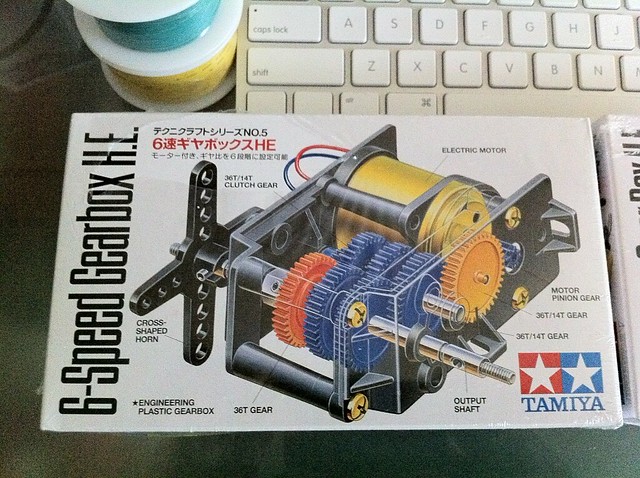
Tamiya Motor kits

Over the winter break I was able to procure these at a hobby shop in the Bay Area. I’ve worked with Tamiya kits since I was in grade school and have found the quality of their kits reliable and efficient.

Upon coming back to New York for the Spring term I decided to assemble one of these kits.’

Tamiya Motor kits

So I’ve learned that motors are either really easy to use of a pain to live with. You either have too much power or not enough torque. Some solutions vary to either getting a bigger motor or something else completely different like a stepper motor.

The Tamiya 6-Speed Gearbox High efficiency is not like a gear box for a car which you can vary the step by moving the gears. In this kit you can move the gears but it would require the disassembly of the entire apparatus.

So let’s begin. In kit comes a variety og gears, a motor, casing, and various parts to interface the motor to a variety of projects.

Tamiya Motor kits

These particular Tamiya kits comes from the Philippines and Japan.

Tamiya Motor kits

The data sheet comes with steps in English and Japanese on how to assemble the kit to the desired ratios. I selected to assemble option E which turns the gears at 19.9 revolutions per minute.

I’ve assembled the motor and will post pictures soon and where I plan to use the motor.

Graffiti Can at the ITP Winter Show

graffiti-15345

The response has been amazing! Thank you to everyone who came on the first day of the show. Images saved by the graffiti can project can be seen here. The last day of the show is today. Come visit us in the dark room and enjoy a lot of great projects by the students of ITP.

http://www.flickr.com/photos/mdelamerced/sets/72157628482669167/

PCOMP Final final project

After numerous revisions it’s finally finished.

physical computing

More or less. Working with small parts is very difficult especially with 30 gauge wire which is barely a thread and breaks easily which is one of the main problems I encountered with this project.

physical computing

The code is working great. But I may have crossed some wires that make the white array and yellow array stay on all the time. But the effect is there. I’m at a point where I don’t want to touch it anymore for fear that it may not work by noon today. I am honestly not satisfied with my work but the important part is I learned a lot with this project in terms of building and fabrication which I really need to work on.

Right now it’s all packed up in a box for transportation to the ITP floor. Thank you for a wonderful experience in Physical Computing.

physical computing

Information display – ICM Finals

A far cry from what I made for the midterms, I think this would be better on another surface other than my computer screen.

So I’ve been able to parse the weather API of Yahoo and the AP headline feeds for news. Using two XML parsing codes is a bit challenging. There’s something in the flickr API that isn’t jist working for me so each image is manually assigned to each weather condition set by Yahoo.


This was the original weather midterm project with no data and just computer drawn images.

This is the raw AP headline feed experiment that I merged with my earlier code.

I think that this information lives outside of our mobile phones and screen but instead it should be around us. I had a last minute inspiration on the subway ride home that I wish this was projected on the window of the train so I know what’s going on above ground.

I wanted to project this on a surface with a kinect camera looking at it at the same time where it would give the false impression of gesture control. But doing certain gestures on the projected surface, it would either refresh the news data or change the weather location.

I think I’ll work on this some more during the break. Code to be posted soon.

PCOMP Final final project

After numerous revisions it’s finally finished.

physical computing

More or less. Working with small parts is very difficult especially with 30 gauge wire which is barely a thread and breaks easily which is one of the main problems I encountered with this project.

physical computing

The code is working great. But I may have crossed some wires that make the white array and yellow array stay on all the time. But the effect is there. I’m at a point where I don’t want to touch it anymore for fear that it may not work by noon today. I am honestly not satisfied with my work but the important part is I learned a lot with this project in terms of building and fabrication which I really need to work on.

Right now it’s all packed up in a box for transportation to the ITP floor. Thank you for a wonderful experience in Physical Computing.

physical computing

Transistor Lab

Very last minute, I’ve gotten to the transistor lab while stuck working on my final project.

physical computing

Design a site like this with WordPress.com
Get started